Last reviewed: July 28, 2026 | Reading time: approximately 18 minutes
You can become a truck dispatcher without a college degree, commercial driver’s license or a general federal “truck dispatcher license.” You do need to understand how freight moves, how carriers earn money, how to communicate with drivers and brokers, and where dispatching can cross into regulated freight brokerage.
A dispatcher is not simply a person who searches a load board. The job is to make and communicate operating decisions for a motor carrier: which load fits the truck, whether the appointment is realistic, what the trip pays after deadhead, whether the broker appears legitimate, what the driver needs to know and what must be documented when the plan changes.
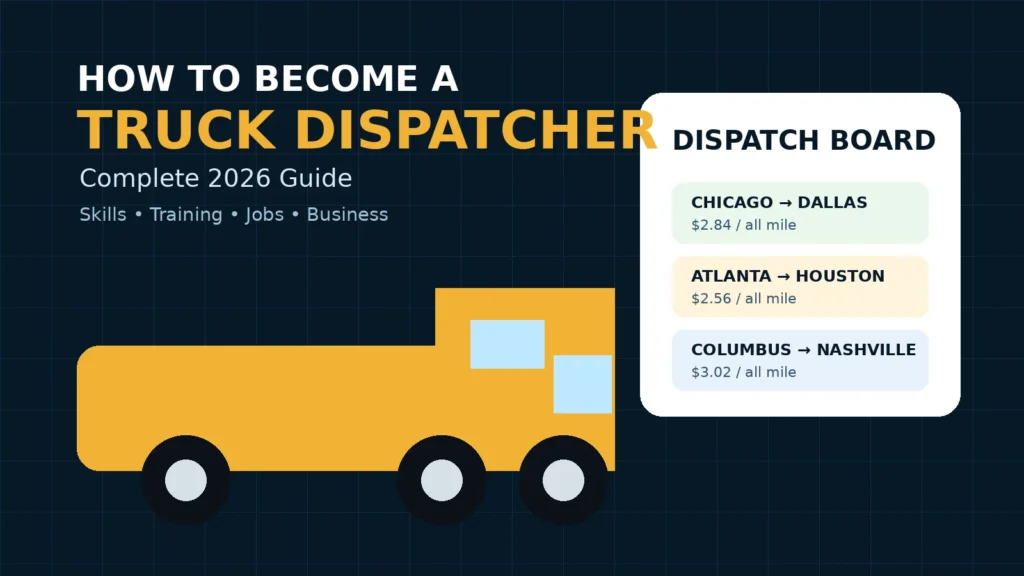
This guide explains the complete path in 2026. It covers the role, required skills, training, realistic practice, employment options, independent-business considerations and the exact steps a beginner can take to become job-ready.
At a glance
- Degree required: Usually no.
- CDL required: No, unless you will also drive a vehicle that requires one.
- Universal dispatcher license: No, but independent services must examine broker-registration rules.
- Time to learn the fundamentals: Often several weeks of structured study and practice.
- Best beginner path: Training, realistic simulations and a supervised employee or assistant role.
What Is a Truck Dispatcher?
A truck dispatcher coordinates the movement of freight for a motor carrier. Depending on the company, the dispatcher may find loads, negotiate rates, prepare driver instructions, monitor pickup and delivery, communicate delays and collect shipping documents.
The broader federal occupational profile for dispatchers describes work such as scheduling vehicles or equipment, relaying information, maintaining operational records, tracking goods and responding to customer problems. Truck dispatching applies those functions to commercial transportation.
A Typical Dispatching Day
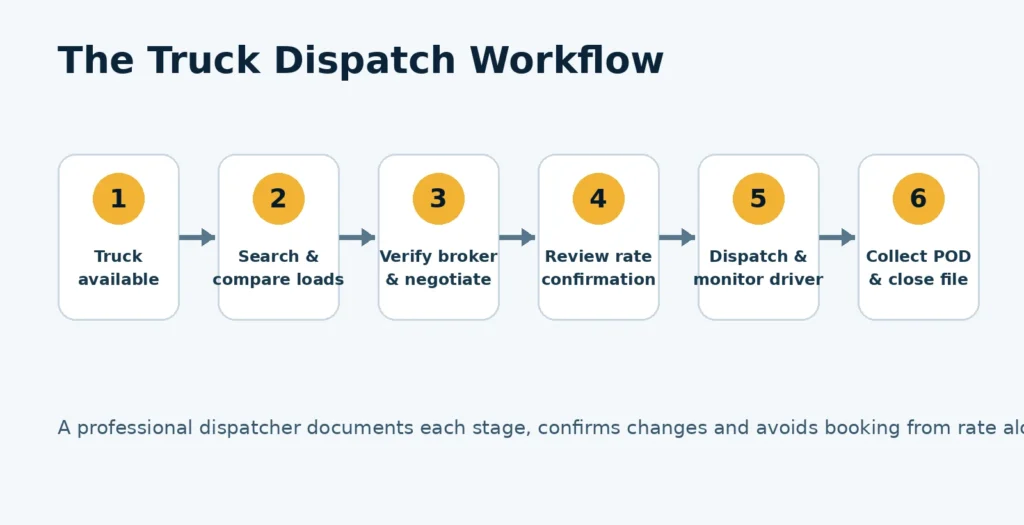
- Review each driver’s location, equipment, available hours and preferred operating area.
- Search for loads that fit the truck and the carrier’s plan.
- Calculate loaded miles, deadhead and all-mile revenue.
- Verify the broker and confirm commodity, weight, appointments and special requirements.
- Negotiate the rate and obtain a written rate confirmation.
- Compare the document with the verbal agreement before the driver moves.
- Send the driver complete pickup and delivery instructions.
- Monitor the shipment and document material updates.
- Collect the signed proof of delivery and close the load file.
In a small carrier, one dispatcher may perform all of these tasks. A larger company may divide them among load planners, driver managers, customer-service staff, safety personnel and billing teams. That is why job advertisements with the title “dispatcher” can describe substantially different work.
Do You Need a License to Become a Truck Dispatcher?
There is no single federal credential called a truck dispatcher license that every dispatcher must obtain. An employee who dispatches trucks for a motor carrier generally works within that carrier’s organization and authority.
The important complication concerns independent dispatch services. Federal Motor Carrier Safety Administration guidance distinguishes brokers and bona fide agents according to what they actually do. A business cannot avoid broker requirements merely by calling itself a dispatcher.
Activities That More Closely Resemble a Carrier’s Agent
- Working under a written agreement with a specific motor carrier.
- Representing the carrier, rather than holding yourself out as the representative of a shipper.
- Searching and negotiating for freight to be transported by that carrier.
- Being paid by the carrier under the agreed compensation structure.
- Operating within the carrier’s instructions and commercial preferences.
- Avoiding control of money owed between the shipper, broker and carrier.
- Avoiding independent allocation of accepted freight among several unrelated carriers.
Activities That May Resemble Brokerage
- Obtaining freight from a shipper before deciding which carrier will receive it.
- Presenting your company as able to arrange transportation independently of a particular carrier.
- Choosing among several carriers after accepting responsibility for a shipment.
- Receiving compensation from the shipper for arranging transportation.
- Handling freight charges or acting as the commercial intermediary between shipper and carrier.
- Accepting responsibility for finding replacement capacity when a selected carrier cannot perform.
Legal caution: This article provides general educational information, not legal advice. An independent dispatch service should have its agreements and actual workflow reviewed by a qualified transportation attorney before operating.
Registered property brokers have separate FMCSA requirements, including registration and financial security. Current FMCSA material explains that brokers and freight forwarders generally must maintain $75,000 in financial security through an eligible surety bond or trust arrangement. That rule does not automatically apply to every dispatcher; it matters when the operation is legally functioning as brokerage.
For a more detailed breakdown, link this section to Do Truck Dispatchers Need a License? and Truck Dispatcher vs. Freight Broker.
Do You Need a CDL, Degree or Certificate?
Commercial Driver’s License
A dispatcher does not normally need a CDL because the dispatcher is not operating the commercial vehicle. A former driver may have valuable practical knowledge, but driving experience is not a legal prerequisite for an office-based dispatch position.
You should still learn enough about driver operations to avoid impossible plans. That includes driving-time limits, appointment timing, vehicle inspections, time zones, traffic, weather, loading delays and the basic limitations of the equipment being dispatched.
College Degree
Most entry-level truck dispatcher positions do not require a four-year degree. Employers commonly place more weight on communication, scheduling, computer ability, reliability and transportation knowledge. A logistics or supply-chain degree can help with advancement, but it does not replace practical dispatch judgment.
Training Certificate
A private training certificate is evidence that you completed a program. It is not a government license and does not guarantee a job. Its value depends on the substance behind it: what you learned, what exercises you completed and whether you can demonstrate the skills in an interview.
A credible certificate is strongest when paired with a small practice portfolio containing load evaluations, broker-call notes, a sample dispatch sheet and a correctly reviewed rate confirmation. See Truck Dispatcher Certification: What It Means for a fuller explanation.
How to Become a Truck Dispatcher in Seven Steps
Step 1: Learn the Freight Participants
Start with the commercial relationships. The shipper has freight. A motor carrier transports it. A broker may arrange transportation between the shipper and carrier. The driver operates the vehicle. The receiver accepts the shipment. A factoring company may advance funds against the carrier’s invoice. The dispatcher coordinates the carrier’s side of the movement.
Confusion about these roles creates larger mistakes later. For example, a dispatcher who thinks the broker “owns the truck” may accept instructions that conflict with the carrier’s safety obligations. A dispatcher who thinks they represent the shipper may accidentally describe services that look more like brokerage.
Step 2: Learn Truck and Trailer Types
A load must fit the equipment, insurance, driver capability and carrier’s operating plan. Learn the basic use and limitations of dry vans, refrigerated trailers, flatbeds, step decks, Conestogas, power-only units, hotshots, box trucks, sprinter vans, car haulers and dump trucks.
Do not memorize only dimensions. Learn the questions that change the booking decision: Is the load floor-loaded? Is driver assist required? Is a pallet exchange expected? Does a flatbed load require tarps? Is the commodity temperature-sensitive? Is the stated weight realistic? Are there multiple stops? Does the carrier’s cargo insurance cover the commodity?
Step 3: Learn Freight Documents
The dispatcher should understand the purpose of the carrier packet, rate confirmation, bill of lading, proof of delivery, lumper receipt, detention record and notice of assignment. You do not need to become a transportation lawyer, but you must know which document controls which part of the transaction and when an inconsistency needs to be raised.
Before dispatching a driver, compare the rate confirmation with the verbal agreement. Check the rate, addresses, appointment times, commodity, weight, number of stops, special instructions, accessorial rules and any clauses imposing unusual deductions. Never assume the first page contains every material term.
Step 4: Learn to Evaluate Loads
New dispatchers often compare loads using loaded rate per mile alone. That can be misleading. A proper evaluation includes deadhead, total trip time, tolls, fuel, appointments, loading risk, destination market and the driver’s available hours.
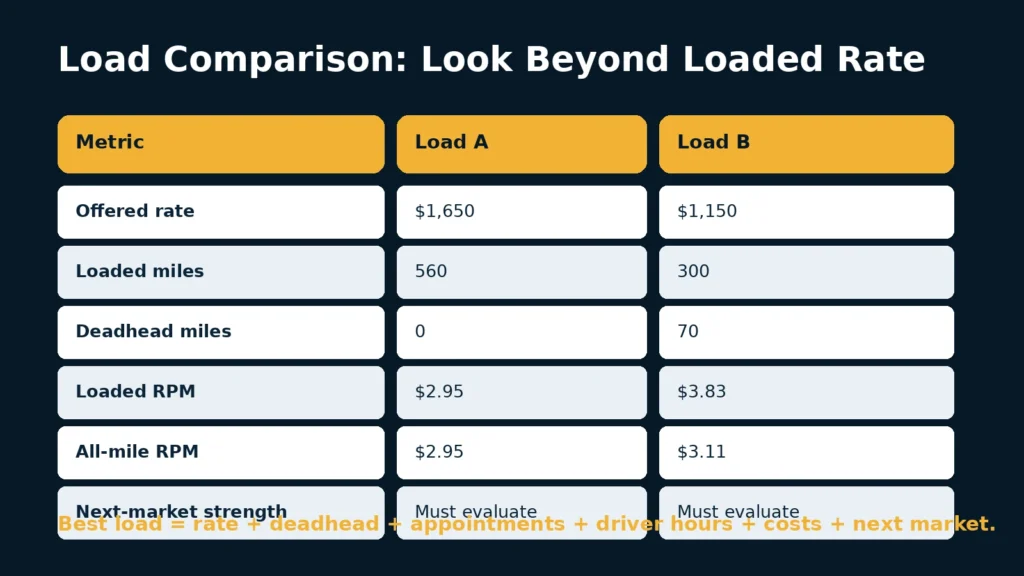
Suppose Load A pays $1,650 for 560 loaded miles with no deadhead. Its loaded and all-mile rate is approximately $2.95 per mile. Load B pays $1,150 for 300 loaded miles but requires 70 empty miles to pickup. Its loaded rate is approximately $3.83, while its all-mile rate falls to approximately $3.11.
Load B still appears stronger by that measure, but the decision is not complete. If it delivers late into a weak market and forces the truck to sit the following day, Load A may produce the better two-day result. Dispatching is a sequence problem: the best choice depends partly on what it allows the truck to do next.
Loaded rate per mile = Offered rate ÷ Loaded miles
All-mile rate = Offered rate ÷ (Loaded miles + Deadhead miles)
Deadhead percentage = Deadhead miles ÷ Total miles × 100
Step 5: Learn Broker Verification and Fraud Controls
A posted load is not proof that the person contacting you is authorized to offer it. Freight fraud can involve broker impersonation, altered email domains, unauthorized re-brokering, false pickup instructions and last-minute payment changes.
Use a documented verification process. Compare the caller’s contact details with trusted records, confirm unusual changes through an independently obtained number, inspect email domains carefully, verify authority and insurance where relevant, and escalate any request to change payment or delivery instructions. A dispatcher should never allow urgency to eliminate verification.
Step 6: Practice Communication and Negotiation
Rate negotiation is not a script in which the dispatcher repeatedly asks for more money. Strong negotiation begins with information. Confirm the truck’s exact location, empty time, equipment, driver hours and acceptable destination before calling. Then establish the load’s commodity, weight, stops, appointment rules and offered rate.
A concise negotiation might sound like this: “We have an empty dry van twelve miles from pickup and can make the appointment. Because the delivery is early Monday and the trip includes two stops, we would need $2,050 to commit the truck.” The dispatcher gives the broker a reason, a number and a clear commitment condition.
Driver communication should be equally precise. Send the confirmation number, addresses, contact details, appointments, commodity, weight, special instructions and the procedure for reporting delays. Avoid sending fragments across several messages when a single organized dispatch sheet would reduce mistakes.
Step 7: Choose Your Entry Route
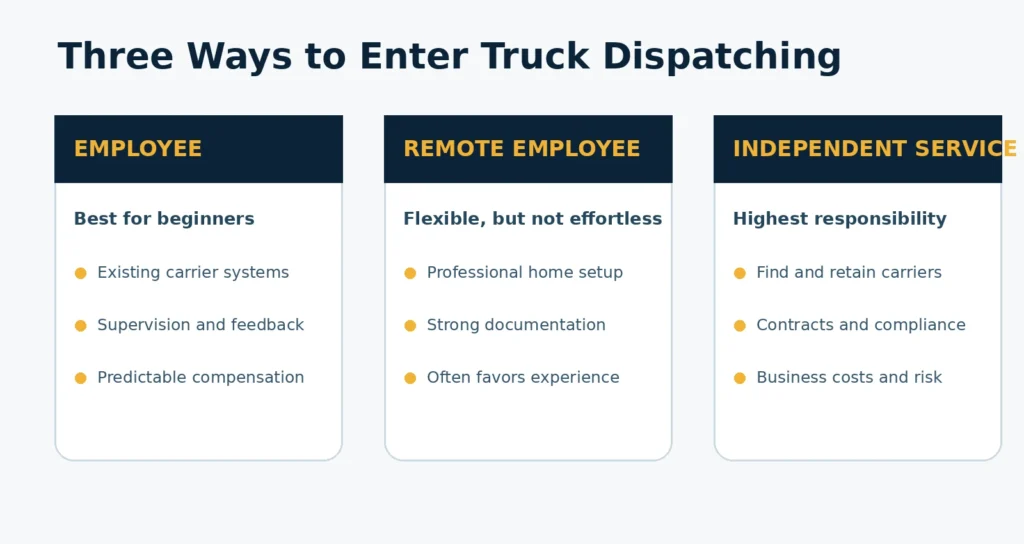
An employee role is usually the lowest-risk route because the carrier already has trucks, systems and commercial relationships. A remote employee role can provide flexibility, although many companies prefer experience because supervision is less direct. An independent dispatch service offers the most control but requires both dispatch competence and the ability to run a compliant business.
A beginner should not assume that starting a business is easier than obtaining a job. The independent owner must find carriers, define services, manage contracts, collect fees, protect data, maintain records and avoid activities that require broker authority. Learn more in How to Start a Truck Dispatching Business.
Essential Truck Dispatcher Skills
Operational Judgment
Operational judgment is the ability to compare imperfect options and choose the one that best serves the carrier. It develops through practice and feedback. The dispatcher must know when a seemingly attractive load creates too much deadhead, when an appointment is unrealistic and when uncertainty is high enough to decline the load.
Clear Communication
Dispatching is communication-intensive. You must ask complete questions, listen carefully, restate critical terms and record changes. Being friendly helps, but accuracy matters more. A polite dispatcher who communicates the wrong appointment time is not performing well.
Numerical Reasoning
You should be comfortable with mileage, percentages, rate-per-mile calculations, estimated revenue, dispatch fees and simple cost comparisons. Advanced mathematics is not required. Consistent arithmetic and correct assumptions are.
Organization and Documentation
A dispatcher may manage several trucks, multiple time zones and a constant stream of calls. Use a repeatable system for truck status, appointments, documents, broker contacts and unresolved issues. Important information should not exist only in a text message or in the dispatcher’s memory.
Emotional Control
Drivers may be frustrated, brokers may apply pressure and facilities may cause delays. The dispatcher must remain factual, identify the next action and avoid turning an operational problem into a personal conflict. Calm communication is a productivity skill.
See the full companion guide: 25 Truck Dispatcher Skills Employers and Carriers Need.
What Legitimate Truck Dispatcher Training Should Include
There is no universal government-approved curriculum for private truck dispatcher courses. Programs should therefore be judged by content, exercises, instructor support, transparency and whether the student learns a complete workflow.
- Freight-industry participants and terminology.
- Truck and trailer types.
- Load-board search and filtering.
- Loaded-mile, all-mile and deadhead calculations.
- Broker verification and fraud warning signs.
- Rate negotiation and professional call structure.
- Rate confirmations, bills of lading and proof of delivery.
- Driver scheduling and hours-of-service fundamentals.
- Detention, layover, truck ordered not used and lumper procedures.
- Carrier onboarding and document management.
- Factoring fundamentals and notices of assignment.
- Dispatch agreements and recordkeeping.
- The legal distinction between carrier representation and brokerage.
- Employment preparation or independent-business planning.
- Realistic exercises with feedback.
A weak program may show how to open a load board but provide little practice in decision-making. A stronger program requires the learner to compare loads, identify missing information, calculate the real trip economics, review documents and explain why a booking should or should not be made.
Read Truck Dispatcher Training: What a Legitimate Program Should Teach before selecting a course.
How to Become a Truck Dispatcher With No Experience
You can enter the occupation without prior trucking employment, but you should replace missing experience with visible preparation. The objective is not to pretend you have dispatched live trucks. It is to show that you understand the workflow and can learn safely.
Build a Practice Portfolio
- Three written load comparisons using all-mile calculations.
- A sample daily truck-status sheet.
- A mock rate-confirmation review with errors highlighted.
- A broker-verification checklist.
- A professional call script and follow-up email.
- A sample dispatch sheet sent to a driver.
- A delay-escalation procedure.
- A course-completion certificate, where applicable.
During an interview, explain your reasoning rather than displaying documents without context. For example: “I rejected this load because the pickup was possible, but the delivery appointment exceeded the driver’s available hours after accounting for the 85-mile deadhead.” That answer demonstrates more value than simply saying you know how to use a load board.
Target Realistic Entry-Level Titles
- Dispatch assistant.
- Fleet coordinator.
- Transportation coordinator.
- Operations assistant.
- Driver-support representative.
- Junior load planner.
- Logistics coordinator.
Smaller carriers, evening shifts and on-site positions may provide a more accessible first opportunity than a fully remote role advertised nationally. The first job should be treated as supervised operational training, not merely as a title.
Continue with Can You Become a Truck Dispatcher With No Experience? and How to Find Entry-Level Truck Dispatcher Jobs.
How Long Does It Take?
| Stage | Practical estimate | Main objective |
|---|---|---|
| Industry fundamentals | 1–2 weeks | Learn roles, equipment and terminology |
| Dispatch workflow | 2–4 weeks | Understand documents, calls and load selection |
| Guided simulations | 2–6 weeks | Practice decisions and receive feedback |
| Entry-level job search | Variable | Demonstrate preparation to employers |
| Supervised proficiency | 3–6 months | Handle routine freight with less assistance |
| Stronger judgment | 6–18 months | Plan strategically and manage exceptions |
These are estimates, not promises. A student may learn terminology quickly but still need months of exposure before managing breakdowns, rejected freight, missed appointments and changing markets with confidence. Read How Long Does It Take to Become a Truck Dispatcher?.
How Much Can a Truck Dispatcher Earn?
National wage data should be interpreted carefully because the Bureau of Labor Statistics category “Dispatchers, Except Police, Fire, and Ambulance” includes dispatchers in several industries, not only trucking. For May 2025, BLS reported approximately 202,800 workers in that category, a mean hourly wage of $26.32, a mean annual wage of $54,740 and a median hourly wage of $24.20.
A truck dispatcher’s actual pay depends on location, shift, experience, equipment, number of trucks, employer size and whether compensation includes bonuses. Independent-service revenue is even more variable and should not be treated as salary.
For example, a dispatch company that invoices $12,000 in one month has not necessarily produced $12,000 of owner income. It may still pay contractors, software, telephones, advertising, insurance, accounting, payment-processing fees and taxes.
For a detailed employee-versus-business comparison, see Truck Dispatcher Salary: Employee, Freelance and Business Earnings.
What Software Do Truck Dispatchers Use?
- Load boards.
- Transportation-management systems.
- Mapping and mileage tools.
- Cloud telephone systems.
- Business email and shared calendars.
- Spreadsheet or database software.
- Electronic document storage.
- Broker and carrier verification resources.
- Accounting and invoicing software.
- Weather and traffic services.
- Electronic logging information provided by the carrier.
Software accelerates the workflow but does not make the commercial decision. A load board can display a rate and lane. It cannot know every detail of the driver’s hours, the carrier’s costs, the customer relationship and the opportunities available after delivery.
Common Beginner Mistakes
Booking From Rate Alone
The highest posted rate is not automatically the best load. Total miles, time, risk and the next market matter.
Failing to Confirm the Driver
Verify the driver’s location, equipment, empty time, available hours and willingness before committing the truck.
Ignoring Written Terms
A verbal agreement is not a substitute for reviewing the complete rate confirmation. Raise discrepancies before dispatch.
Weak Fraud Controls
Do not rely on a familiar logo, caller ID or professional-looking email. Verify through independent records and a documented process.
Taking Too Many Trucks
A beginner who accepts more trucks than they can monitor creates risk for every carrier involved. Build repeatable systems before expanding.
Promising Guaranteed Revenue
No responsible dispatcher can guarantee a carrier’s weekly gross without controlling market conditions, driver availability, equipment, location and operating costs. Use documented assumptions rather than exaggerated promises.
Job-Ready Checklist
- Can you explain the roles of shipper, broker, carrier, driver, receiver and dispatcher?
- Can you identify common equipment types and ask the right compatibility questions?
- Can you calculate loaded rate, all-mile rate and deadhead percentage?
- Can you compare two loads using timing and destination as well as rate?
- Can you conduct a structured broker call?
- Can you review a rate confirmation for material terms?
- Can you explain the bill of lading and proof of delivery?
- Can you identify common fraud warning signs?
- Can you send complete driver instructions?
- Can you document a delay and escalate it professionally?
- Can you explain the basic boundary between dispatching and brokerage?
- Can you complete a realistic practice scenario without step-by-step prompting?
If several answers are no, continue training before accepting responsibility for live freight. The purpose of preparation is not perfection. It is to reduce preventable errors and make supervision productive.
Build Practical Truck Dispatcher Skills
Dispatcher101 provides structured training in load evaluation, broker communication, paperwork, carrier onboarding and dispatch workflow. Training is preparation—not a guarantee of employment or income.
Explore the Dispatcher101 Course
Frequently Asked Questions
Can anyone become a truck dispatcher?
Many people can learn the role, but successful dispatching requires communication, organization, numerical reasoning and calm decision-making. Completing a course does not automatically make someone competent.
Can I become a dispatcher without experience?
Yes. Learn the complete workflow, complete realistic exercises, build a small practice portfolio and target assistant or entry-level roles where your work can be supervised.
Can truck dispatchers work from home?
Yes. Remote dispatching requires reliable internet, a professional phone setup, secure document storage and disciplined communication. Employers may prefer experienced candidates for remote roles.
Do dispatchers need an MC number?
Not automatically. An employee dispatcher does not obtain broker authority merely to work for a motor carrier. An independent service must examine whether its actual activities constitute carrier representation or regulated brokerage.
Is a dispatcher certificate required?
No universal federal dispatcher certificate is required for ordinary employment. A certificate can show course completion, but employers will still evaluate practical knowledge and reliability.
How quickly can I get a job?
There is no guaranteed timeline. It depends on your preparation, prior experience, location, schedule flexibility, resume, interview performance and the employers hiring at that time.
Is truck dispatching the same as freight brokering?
No. A dispatcher generally works for or represents a motor carrier. A broker operates as an intermediary arranging transportation. Legal classification depends on the services actually performed.
What is the best way to learn?
Combine structured instruction with document review, calculations, simulated calls, load-comparison exercises and supervised experience. Passive video watching alone is insufficient.
Sources and Editorial Notes
- FMCSA: Final Guidance Clarifying Broker and Bona Fide Agent Definitions
- FMCSA: Broker Registration
- FMCSA: Broker and Freight Forwarder Financial Responsibility
- U.S. Bureau of Labor Statistics: May 2025 National Employment and Wage Data
- O*NET: Dispatchers, Except Police, Fire, and Ambulance
Editorial note: Wage figures cover the broader BLS dispatcher occupation and are not a trucking-only salary estimate. Legal and registration sections summarize general federal guidance and are not a substitute for advice based on a specific business model.
Update log: Published July 28, 2026. Reviewed against May 2025 BLS wage data, O*NET’s 2026 occupational profile and current FMCSA broker/dispatch guidance.
link gacor situs slot bandar togel toto macau slot88 toto togel toto slot slot gacor hari ini togel 4d togel 4d login bento4d toto macau toto slot bento4d login bento4d daftar bento4d