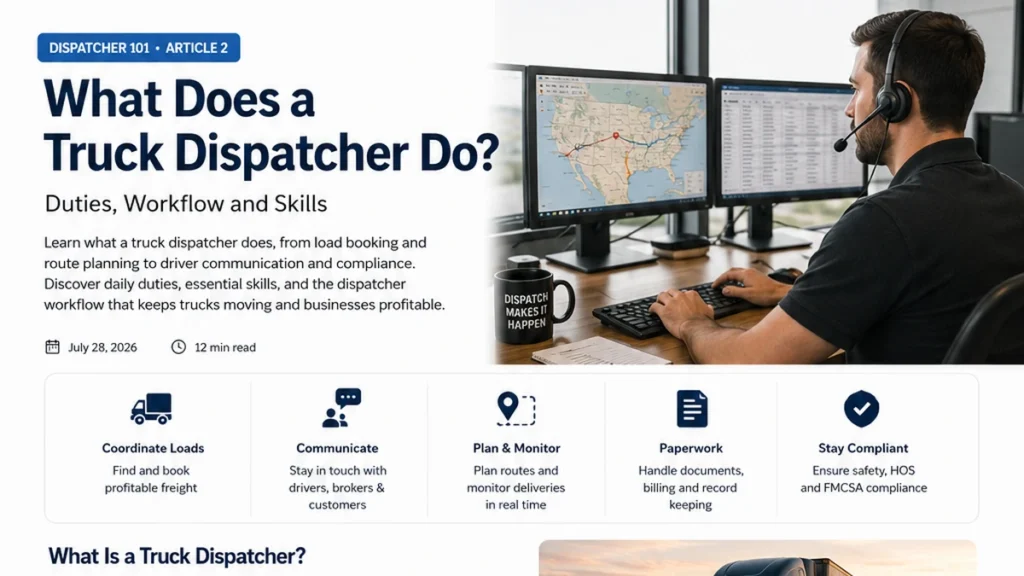
A truck dispatcher coordinates drivers, trucks, freight, schedules, communication, and paperwork so loads move safely, on time, and profitably. Depending on the carrier and job structure, a dispatcher may search for loads, negotiate rates, plan routes, send pickup and delivery instructions, monitor progress, solve delays, collect documents, and prepare the truck’s next move.
The dispatcher usually does not drive the truck. Instead, the dispatcher manages the information and decisions behind the driver’s work. The best dispatchers do more than “find loads.” They protect the carrier’s time, reduce empty miles, maintain clear communication, and prevent small problems from becoming expensive ones.

Table of contents
- What is a truck dispatcher?
- Core truck dispatcher duties
- Daily workflow
- How dispatchers evaluate loads
- Safety and compliance responsibilities
- Essential dispatcher skills
- Employee vs. independent dispatchers
- Frequently asked questions
What Is a Truck Dispatcher?
A truck dispatcher is a transportation professional who coordinates freight movement for a motor carrier or trucking company. The dispatcher serves as a central communication point between the driver, carrier, freight broker, shipper, receiver, warehouse, safety team, maintenance provider, and billing staff.
The U.S. Department of Labor’s O*NET system describes dispatch work as scheduling workers or vehicles, preparing run schedules, communicating assignments, maintaining records, monitoring equipment locations, arranging repairs, and warning personnel about traffic, weather, construction, or other hazards. Those broad duties become highly specific in trucking because every decision affects a commercial vehicle, a driver’s available hours, a customer appointment, and the carrier’s operating costs.
There is no single universal dispatcher job description. A dispatcher at a large fleet may manage assigned freight and driver communication without searching load boards. A dispatcher for a small carrier may handle nearly the entire load cycle—from finding freight to collecting proof of delivery.
What Does a Truck Dispatcher Do? 10 Core Duties
1. Confirm the Driver, Truck, and Trailer Are Available
Before looking for freight, the dispatcher needs an accurate picture of the carrier’s available capacity. That normally includes:
- The driver’s current location
- When the truck will be empty
- Available driving and on-duty hours
- Truck and trailer type
- Trailer dimensions and weight capacity
- Equipment condition
- Preferred lanes and home-time requirements
- Special endorsements or load restrictions
- The carrier’s minimum acceptable rate
A dispatcher who skips this step may spend time negotiating a load the truck cannot legally, safely, or practically haul.
2. Search for Suitable Freight
For carriers that rely on the spot market, the dispatcher may search load boards, contact approved brokers, review direct-customer opportunities, and compare available loads.
The goal is not to select the first load with a large total price. A strong dispatcher evaluates the complete movement: loaded miles, deadhead miles, pickup time, delivery time, commodity, weight, facility reputation, tolls, weather, reload options, and the driver’s remaining hours.
3. Evaluate the Real Value of a Load
Dispatchers compare loads using more than the advertised rate per loaded mile. A useful evaluation considers total miles and total time.
Example: A load pays $2,100 for 700 loaded miles, but the truck must travel 100 empty miles to pick it up. The gross revenue is about $2.63 per total mile before fuel, tolls, driver compensation, maintenance, insurance, and other operating expenses.
The same load may be attractive for one truck and poor for another. The decision depends on where the truck starts, how quickly it can load, whether the delivery appointment is realistic, and what freight is likely to be available afterward.
4. Negotiate and Book the Load
When negotiation is part of the dispatcher’s role, the dispatcher communicates with the broker or shipper to confirm the rate and important terms. Effective negotiation uses operational facts rather than emotion.
A dispatcher may support a rate request with:
- Current market capacity
- Deadhead distance
- Short notice or difficult appointment times
- Extra stops
- Special handling requirements
- Tolls or limited reload options
- Documented waiting-time risk
Before accepting, the dispatcher should confirm the legal names of the parties, pickup and delivery details, commodity, weight, equipment requirements, rate, accessorial terms, and payment instructions.
5. Review the Rate Confirmation
The rate confirmation is not a formality. It is the written record of the agreed load terms. The dispatcher should compare it with the verbal agreement and look for missing or unfavorable details.
Important items include:
- Carrier name and motor-carrier number
- Broker name and contact information
- Pickup and delivery addresses
- Appointment dates and times
- Commodity, weight, and equipment
- Total rate and payment terms
- Detention, layover, truck-ordered-not-used, and stop-off terms
- Tracking requirements
- Required documents and submission deadlines
If something is wrong, the dispatcher should resolve it before the truck is committed whenever possible.
6. Plan the Route and Schedule
Route planning is more than entering two addresses into a consumer navigation app. A dispatcher must account for commercial-vehicle restrictions, truck-safe roads, low clearances, bridge and weight limits, tolls, construction, weather, fuel stops, parking, appointment times, and the driver’s legal hours.
The driver remains responsible for operating the vehicle safely. The dispatcher’s role is to provide a realistic plan and avoid creating a schedule that depends on unsafe or illegal driving.
7. Send Clear Dispatch Instructions
Once the load is booked, the dispatcher sends the driver a complete, readable load assignment. It should contain the information needed to execute the load without searching through multiple messages.
A practical dispatch message may include:
- Load or confirmation number
- Broker and emergency contacts
- Pickup and delivery addresses
- Appointment times and time zones
- Commodity and weight
- Pickup numbers or reference numbers
- Special instructions
- Tracking requirements
- Document requirements
- Known parking, route, or facility notes
Clear communication reduces missed appointments, wrong-location arrivals, and preventable service failures.
8. Track the Load and Communicate Updates
During transit, the dispatcher monitors progress and keeps the correct parties informed. That may involve checking arrival and departure times, reviewing tracking data, speaking with the driver, and sending status updates to the broker or customer.
Useful updates answer four questions:
- Where is the truck?
- What has already happened?
- Is the current appointment still realistic?
- Does anyone need to take action?
Professional dispatchers communicate early. Waiting until a missed appointment is unavoidable removes most of the options for solving the problem.
9. Solve Problems During the Load
Trucking rarely follows a perfect plan. Dispatchers routinely manage delays, breakdowns, rejected freight, appointment changes, missing pickup numbers, weather events, traffic closures, loading problems, driver illness, damaged cargo reports, and communication failures.
A reliable problem-solving sequence is:
- Confirm the facts.
- Protect safety first.
- Identify the decision-maker.
- Present realistic options.
- Document instructions and approvals.
- Update every affected party.
- Record the final outcome.
The dispatcher should not promise an outcome that depends on the driver violating a rule, ignoring a mechanical issue, or operating unsafely.
10. Collect Documents and Close the Load
After delivery, the dispatcher may collect and organize documents such as:
- Signed bill of lading
- Proof of delivery
- Lumper receipt
- Scale ticket
- Detention records
- Fuel or toll receipts
- Damage or shortage notation
- Revised rate confirmation
Complete, readable, and timely documents support invoicing and reduce payment delays. The dispatcher also updates the truck’s location and availability so the next load can be planned.
The Daily Workflow of a Truck Dispatcher
A dispatcher’s day is not a fixed sequence because multiple trucks may be loading, driving, delivering, or waiting at the same time. Still, the basic workflow usually follows a repeating cycle.
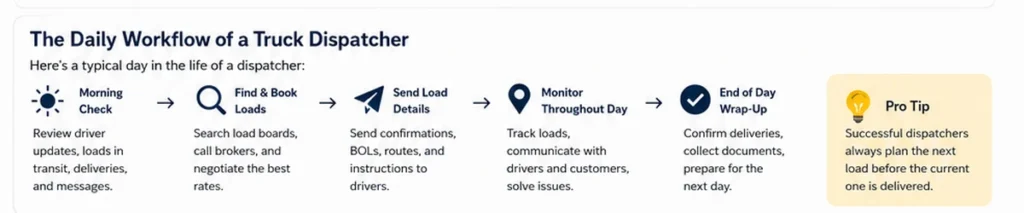
Morning Operational Review
The dispatcher reviews trucks in transit, upcoming deliveries, available driver hours, overnight messages, tracking alerts, weather, and any loads that need immediate attention.
Load Planning and Booking
The dispatcher searches for freight or reviews assigned loads, compares options, negotiates where authorized, confirms the terms, and updates the carrier’s plan.
Execution and Monitoring
The dispatcher sends load information, verifies pickup progress, monitors transit, communicates updates, and handles exceptions.
Delivery and Documentation
The dispatcher confirms delivery, collects proof of delivery and receipts, records accessorial events, and transfers documents to billing or factoring.
Next-Load Preparation
Good dispatchers plan ahead. They begin evaluating the next movement before the current load is complete, but they avoid committing to a schedule that depends on an uncertain delivery or unrealistic driver hours.
How a Dispatcher Chooses Between Two Loads
Suppose two loads are available for the same dry van:
| Factor | Load A | Load B |
|---|---|---|
| Advertised rate | Higher | Lower |
| Deadhead | Long | Short |
| Delivery | Next-day appointment | Same-day or flexible |
| Destination | Weak reload market | Strong reload market |
| Facility risk | Long historical delays | Usually efficient |
The higher-paying load is not automatically more profitable. Load B may produce better weekly revenue because it requires less empty travel, uses fewer hours, and places the truck near stronger outbound freight.
This is why dispatching is an operational decision-making job—not simply a load-board search job.
Truck Dispatcher Safety and Compliance Responsibilities
A dispatcher is not a substitute for the carrier’s safety department, legal counsel, or the driver’s professional judgment. However, dispatch decisions directly affect whether a schedule is realistic.
Hours of Service
For most property-carrying drivers subject to the standard federal rules, FMCSA summarizes the main limits as a maximum of 11 driving hours after 10 consecutive hours off duty, no driving beyond the 14th consecutive hour after coming on duty, a 30-minute interruption after 8 cumulative hours of driving, and a 60- or 70-hour limit over 7 or 8 consecutive days. Exceptions and special provisions may apply.
A dispatcher should review the driver’s actual available hours before booking and again before sending a time-sensitive plan. “The mileage should fit” is not enough. Loading time, traffic, breaks, fueling, parking, and appointment delays all consume the operating window.
Electronic Logging Devices
Electronic logging devices synchronize with the vehicle engine to record driving time and support hours-of-service records. Dispatchers may use ELD information to understand available hours and truck location, but they should not treat an estimate as permission to create an impossible schedule.
Do Not Pressure Unsafe or Illegal Operation
A professional dispatcher does not tell a driver to falsify logs, ignore a mechanical defect, speed, use a prohibited route, or continue in unsafe conditions. When safety and service conflict, safety controls the decision.
Dispatcher Versus Broker
A dispatcher commonly operates as part of a carrier’s organization or under the carrier’s direction. A freight broker arranges transportation between shippers and authorized motor carriers under broker authority.
The legal classification depends on the facts, not the business title. FMCSA has issued guidance to help dispatch services, carriers, and brokers determine when an operation may require broker authority. An independent dispatch service should use a written carrier agreement, avoid misrepresenting its role, and obtain qualified legal or compliance advice when its activities could cross into brokerage.
For a deeper comparison, link this section to: Truck Dispatcher vs. Freight Broker: Differences, Rules and Careers.
Essential Skills Every Truck Dispatcher Needs
Communication
Dispatchers communicate with people who have different priorities. Drivers need clear instructions. Brokers need accurate updates. Customers need realistic expectations. Strong communication is concise, specific, professional, and documented.
Negotiation
Negotiation is not aggressive arguing. It is the ability to understand the load, explain the carrier’s costs and constraints, ask precise questions, and reach workable terms while protecting the business relationship.
Problem Solving
Dispatchers must separate facts from assumptions, identify the urgent issue, compare options, and act quickly without creating a larger problem.
Time Management
A dispatcher may handle several active loads, phone calls, emails, documents, and deadlines at once. Prioritization matters more than simply working faster.
Attention to Detail
A wrong appointment time, missing pickup number, incorrect address, overlooked time zone, or unreadable proof of delivery can create major delays. Professional dispatchers use repeatable checklists.
Route and Geographic Knowledge
Dispatchers should understand major freight lanes, regional market patterns, common truck routes, time zones, seasonal weather, toll areas, and locations with limited parking or reload options.
Technology Skills
Common tools include transportation-management systems, load boards, email, spreadsheets, document scanners, ELD portals, tracking platforms, accounting or factoring portals, and commercial-route software.
Emotional Control
Dispatching can be stressful because delays and conflicts happen in real time. A dispatcher who stays calm can gather better information, communicate more clearly, and make better decisions.
What Makes a Good Truck Dispatcher?
A good truck dispatcher creates predictable operations in an unpredictable environment. The dispatcher:
- Plans before the truck becomes empty
- Checks details before committing
- Understands the driver’s legal and practical limits
- Communicates problems early
- Documents agreements and changes
- Protects relationships without accepting bad terms
- Measures the result across the week, not only one load
- Learns from service failures and updates the process
The dispatcher’s real product is not a phone call or a booked load. It is a controlled, repeatable freight operation.
Employee Dispatcher vs. Independent Dispatch Service
| Area | Employee Dispatcher | Independent Dispatch Service |
|---|---|---|
| Who directs the work? | The motor carrier or fleet employer | The carrier under a service agreement |
| Typical compensation | Hourly pay or salary | Flat fee or agreed service fee |
| Tools | Usually supplied by employer | Usually supplied by the dispatch business |
| Business responsibilities | Limited | Contracts, client acquisition, bookkeeping, data security, and compliance |
| Broker-authority risk | Usually lower when acting within the carrier organization | Must carefully evaluate activities under FMCSA guidance |
An independent dispatch service is not automatically a freight broker, but calling a business “dispatching” does not automatically keep it outside broker rules. The actual activities and relationships determine the classification.
Common Truck Dispatcher Mistakes
- Booking before confirming driver hours and equipment
- Comparing rates using loaded miles only
- Ignoring deadhead, tolls, time, or the destination market
- Accepting verbal terms without reviewing the written confirmation
- Sending incomplete load details
- Waiting too long to report a delay
- Failing to document detention or accessorial events
- Planning a pickup before the current delivery is reliable
- Pressuring a driver instead of rebuilding the plan
- Trying to manage too many trucks without a system
How to Learn Truck Dispatching
Truck dispatching is learned fastest through a structured combination of industry knowledge and realistic practice. A serious training program should teach load evaluation, carrier setup, broker communication, rate negotiation, rate-confirmation review, route and hours planning, driver communication, problem management, documentation, and the dispatcher-broker boundary.
Reading about dispatching is useful, but job readiness requires repeated practice with realistic load scenarios and operating decisions.
Build Practical Truck Dispatching Skills
Dispatcher 101 teaches the workflow behind professional dispatching—from evaluating freight and communicating with brokers to planning loads, supporting drivers, and organizing documents.
Explore the Dispatcher 101 Course
Frequently Asked Questions
What does a truck dispatcher do in simple terms?
A truck dispatcher organizes the movement of freight. The dispatcher coordinates drivers, trucks, loads, routes, appointments, communication, and documents so the carrier can complete deliveries safely and efficiently.
Does a truck dispatcher find loads?
Some dispatchers find and negotiate loads, especially for small carriers using the spot market. Others work for fleets where a planner, broker, or sales department assigns the freight.
Does a truck dispatcher need to drive a truck?
No. Dispatchers generally do not drive as part of the job. Driving experience can provide useful perspective, but dispatching is an operations and communication role.
Is truck dispatching difficult?
It can be demanding because the dispatcher must manage time-sensitive information, multiple people, changing conditions, and financial consequences. Systems, checklists, communication skills, and realistic practice make the work more manageable.
Can a truck dispatcher work from home?
Yes. Many dispatch tasks can be handled remotely with reliable internet, phone service, secure document storage, load-board access, routing tools, and clear communication procedures.
How many trucks can one dispatcher manage?
There is no universal number. Capacity depends on the freight type, appointment complexity, trip length, driver experience, level of customer reporting, available technology, and administrative support. Service quality should determine the workload—not an arbitrary truck count.
What is the most important dispatcher skill?
Clear decision-making supported by accurate communication is the core skill. Negotiation, organization, route knowledge, attention to detail, and problem solving all depend on it.
Final Answer: What Does a Truck Dispatcher Do?
A truck dispatcher coordinates the full operating cycle behind a freight movement: capacity, load selection, rate terms, route planning, driver instructions, tracking, problem solving, documentation, and next-load preparation.
The best dispatchers protect safety, driver time, customer service, and carrier profitability at the same time. They do not merely react to problems. They build systems that reduce the number of problems and make the remaining ones easier to solve.
Suggested internal links:
- How to Become a Truck Dispatcher: Complete 2026 Guide
- Truck Dispatcher Training: What a Legitimate Program Should Teach
- Truck Dispatcher vs. Freight Broker
- Do Truck Dispatchers Need a License?
Authoritative references:
- O*NET: Dispatchers, Except Police, Fire, and Ambulance
- FMCSA: Summary of Hours-of-Service Regulations
- FMCSA: Electronic Logging Devices
- FMCSA: Broker and Bona Fide Agent Guidance